

I have been reading Carol Dweck’s Mindset: The New Psychology of Success, which examines the difference between what she calls a fixed mindset and a growth mindset. This idea is now very familiar: some people understand ability as something relatively fixed, while others see it as something that can be developed. The distinction matters because it changes how we respond to failure. If ability is fixed and a reflection of who we are and will always be, failure becomes threatening. If ability can be developed, failure becomes information. Reading Dweck has made me think about a related question:
How do we reconcile the belief that we can improve at anything with the fact that we are not equally suited to every pursuit?

We live in a society that places enormous value on natural talent. We want to be intelligent, athletic, artistic, entrepreneurial, successful—and, ideally, to make it look effortless.
Natural talent makes achievement seem more extraordinary, almost god-like: the gifted artist, athlete, or mathematician appears to possess something rare that others simply do not. This is why we are so drawn to talent: it makes greatness seem grander, more mysterious, and less accessible. Hard work, on the other hand, tells a more human story. When someone becomes excellent through years of practice, failure, and persistence, their achievement is more relatable, and therefore more attainable. We can imagine following the same path ourselves.
Yet there is a strange contradiction in how we think about talent. Outwardly, we tend to exaggerate it in ourselves; inwardly, we over-attribute it to others.
We want to appear naturally talented because talent carries a certain prestige. It allows us to claim the status of being gifted without exposing the years of failure underneath it. Talent becomes a form of social currency: appearing naturally capable helps us establish our place in the hierarchy without revealing the struggle required to get there.
But when we look at someone else’s success, the same idea can work in reverse. We are quick to attribute excellence to innate ability: They were just gifted. They have something I don’t. This is self-protective. If their achievement was primarily the product of rare ability, we do not have to confront the possibility that their effort and discipline played a larger role than we would like to admit. And face the uncomfortable reality that if we had worked as hard, we might have achieved something similar.
There is an inherent dissonance here. We want innate ability to be evidence of our exceptionalism, but also an explanation for why someone else is beyond our reach. In both cases, we distort reality to protect our self-image; perception begins to matter more than reality.
The result is a deeply insecure relationship with ability. We become preoccupied with appearing exceptional while avoiding the vulnerability of finding out where we actually stand. We choose activities at which we are already comfortable, avoid situations in which we might look incompetent, and seek affirmation rather than criticism. Once that happens, we become more invested in proving what we are to others than in discovering what we could become for ourselves.

This is where the conversation about growth becomes more complicated. There is a tendency, particularly when discussing growth mindset, to overcorrect. We tell young people that they can become anything if they simply work hard enough. It is an appealing message, but it isn’t quite true. People differ in their natural abilities. Some have unusually strong visual perception; others have extraordinary musical sensitivity, mathematical intuition, verbal ability, physical coordination, or social intelligence. Effort matters enormously, but effort does not make all differences between people disappear. Talent is a real differentiator.
I find it useful to think about this in terms of a simple framework:
Talent sets our theoretical potential; development builds our ability, while effort and luck shape how much of that potential we realize as achievement.
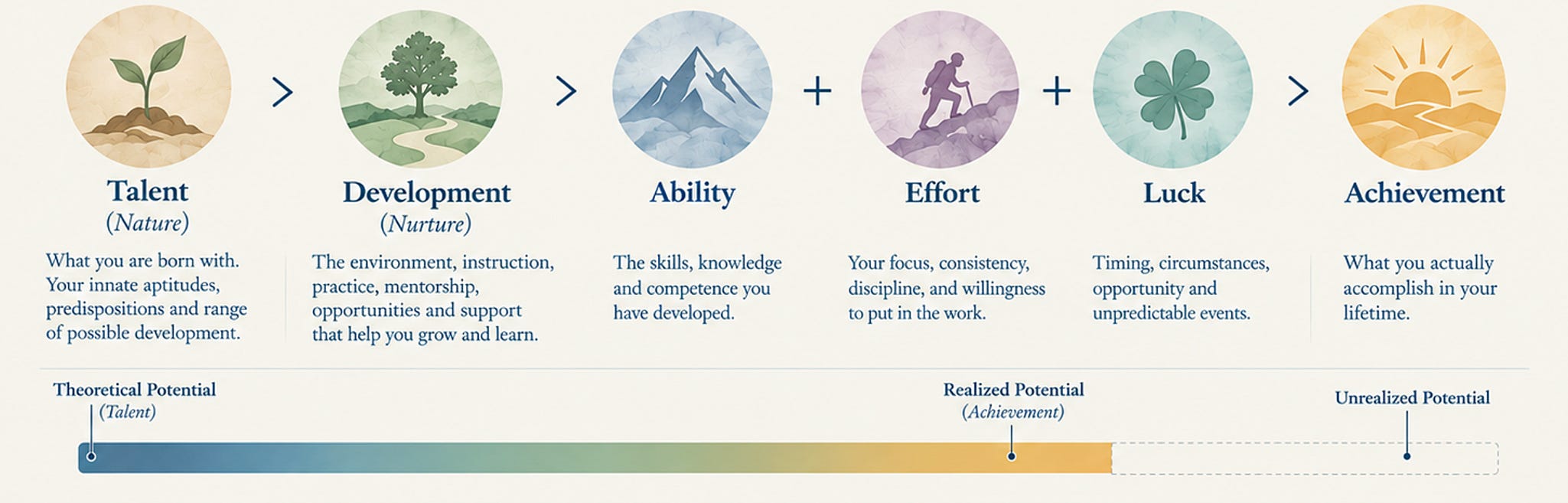
In my framework, theoretical potential is the talent we are born with: the range of what our natural endowment might allow us to become. Development—the environment, instruction, opportunities, practice, mentorship, and challenges we encounter—determines how much of that theoretical potential becomes accessible to us. Our abilities emerge from both nature and nurture: biology provides certain predispositions, while environment and experience influence how they develop.
Achievement is realized potential: what we actually accomplish over the course of a lifetime. Ability matters, but ability alone does not determine achievement. Effort determines how much of our ability we put into practice, while luck influences the opportunities we encounter. We cannot control all the circumstances that shape our lives, but we have far more control over our effort—and sustained effort can create opportunities for our abilities to become achievement.
The purpose of this framework is not to calculate these quantities precisely. We cannot know someone’s theoretical potential with certainty, nor can we know in advance what they might have achieved under different circumstances. But conceptually there is a difference between what a person may have been capable of becoming and what they ultimately become. And that difference matters. The gap between the two can be thought of as unrealized potential.
If potential is what might become possible, then discovering it requires looking beyond what someone can do today. A person with an exceptional eye for drawing may produce terrible drawings when they first pick up a pencil. Someone with strong reasoning ability may struggle in an introductory science class because they have not yet acquired the necessary vocabulary or technical knowledge. Present performance, in other words, can reflect not only what someone is capable of, but also what they have had the opportunity to learn and develop.
The early learning curve can be deceptive: we often struggle through an initial period of incompetence before our underlying abilities become visible. Discovering talent therefore requires a peculiar combination of exposure, effort, and blind faith.
This is one reason early exposure matters so much. If we want people to discover what they are capable of, we need to expose them to a wide range of activities while they are young. The purpose of such exposure is not to make every child equally proficient at everything. It is to give each child enough opportunities to reveal where their abilities may lie. And once those abilities begin to emerge, we should take them seriously.

There are three areas that I think a good learning environment should prioritize:
1. Talent Discovery
Children should have broad, high-quality exposure to different domains, and adults should pay attention to the differences that emerge. Parents, teachers, and mentors should look not only at whether a child is succeeding, but at how they think, what they notice, what seems intuitive to them, what kinds of problems they persist through naturally, and where they demonstrate unusual potential. This requires honest observation.
Honest, constructive feedback may be one of the most encouraging things a teacher can provide. Without it, we are left to judge our abilities for ourselves—and our self-perception is notoriously unreliable.
2. Development of Abilities
If a child demonstrates an unusual aptitude for mathematics, music, drawing, writing, or working with people, we should encourage them to pursue that ability more seriously. Give them more challenging problems. Introduce them to people who have mastered the field. Allow them to practice more deeply. There is a difference between telling a child, “You’re a math person,” and telling them, “You seem to have an unusual aptitude for mathematics. Let’s see how far you can take it.” The first creates a restricted identity while the second creates a possibility.
Nurturing someone’s strongest abilities does not mean confining them to a single domain. We should encourage people to develop their natural strengths while also teaching them that they can grow in areas where they are weaker. Not because everyone needs to become equally good at everything, but because breadth gives us perspective—and helps us understand and empathize with others.
Once we accept that human beings have genuinely different strengths, it becomes easier to see society not as a hierarchy of impressive and unimpressive people, but as an ecosystem of complementary abilities.
3. Matching Ability to Opportunity
Once we recognize ability, we need to match it to the right opportunities. The opportunities available to someone should reflect not only what they are good at, but what society needs those abilities to accomplish.
The contexts in which particular competencies can be expressed change dramatically over time. Good teachers and leaders understand this. Their job is not simply to identify what someone can do, but to recognize where those abilities might become valuable as the world changes. They help people imagine individualized possibilities that may not yet have obvious names or established paths.
One purpose of education should be to help people answer not only, “What do I want to do?” but also, “What am I capable of contributing?” and “What does society require of me?”
Meaningful work is unlikely to be found through passion alone; it often lies at the intersection of what we care about, what we can become good at, and what other people need.

All of this depends on a deceptively difficult task: seeing ourselves as we actually are.
Growth begins when we face the mirror. Yet there is something psychologically uncomfortable about looking at oneself honestly. Knowing what you are good at is not arrogance. Knowing what you are bad at is not failure. Both are forms of information.
The correct response to talent is neither to worship it nor to deny it. We should seek opportunities to discover our abilities, environments in which to develop them, and people who are willing to tell us the truth.
The purpose of this process is not to make everyone exceptional, but to help us understand ourselves well enough to find where we belong—and others well enough to appreciate the different ways they contribute. We don’t all need the same talents. In fact, society depends on the fact that we don’t all have the same ones. Our differences are the necessary components of a healthy, functional society.
Perhaps, then, the measure of a successful society is not how many exceptional people it produces, but how little human potential it leaves unrealized.