

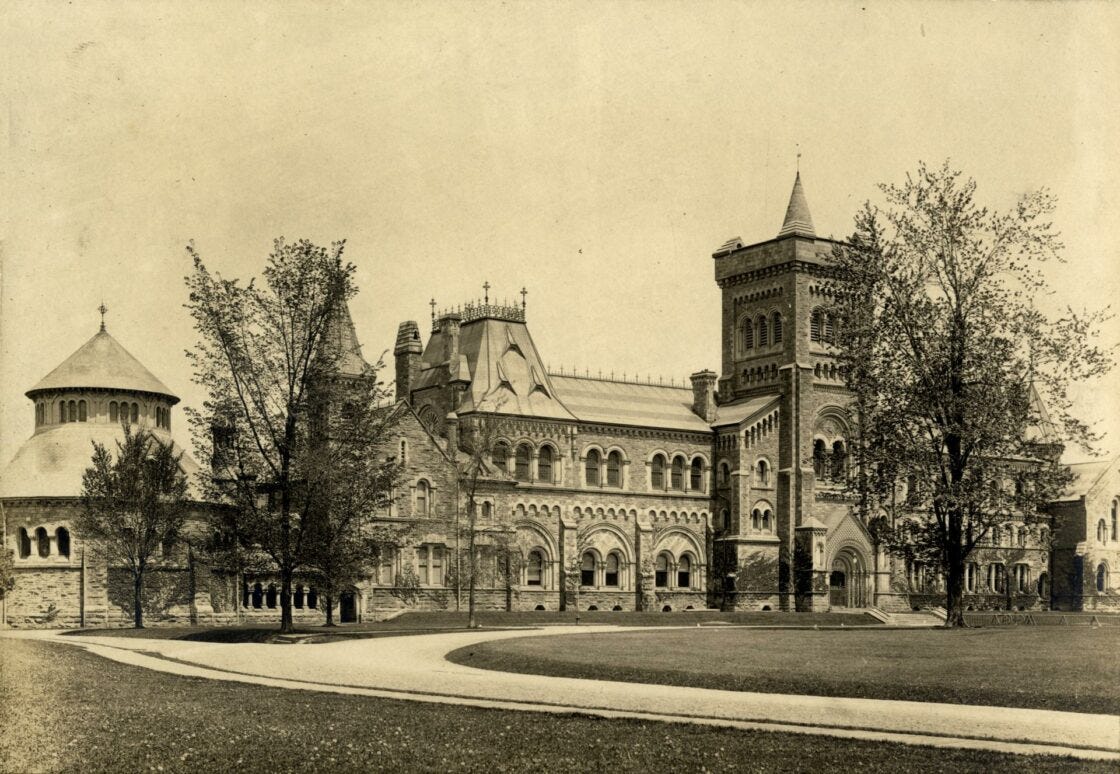
Five years is a long time to spend in any environment, and the experience inevitably becomes about more than just the work itself. In retrospect, my five years in graduate school at the University of Toronto fall naturally into distinct chapters.
Year 1: Learning the Craft
I arrived at graduate school with a mixture of uncertainty and excitement. I often questioned whether I was cut out for it. Yet, I was also exhilarated by the idea of entering an entirely novel world: a new city, university, intellectual environment, and community. I was surrounded by unfamiliar ideas, difficult questions, and people who seemed to know so much about things I wanted to understand. I read constantly, asked endless questions, and loved the feeling of discovering how much there was still to learn. At the time, the world of science felt expansive and full of possibility.
Year 2: Building Through Experimentation
The novelty gradually gave way to the harder, quieter work of becoming competent. Much of my second year was spent troubleshooting failed experiments, refining protocols, repeating what did not work, and eventually learning how to generate reliable data. I learnt that good science is painfully slow. There was little immediate reward, but knowledge accumulated and technical judgment developed through repetition and failure. Managing to sustain that high effort, despite the immense self-doubt, became an important foundation for everything that followed.
Year 3: From Learning to Discovery
Then the experiments started working. I became better at asking meaningful questions and, increasingly, at answering them. My confidence grew not only as hypotheses I developed were supported by the data, but as I began to contribute meaningfully to the work of others. I found myself increasingly engaged in scientific discussions across different environments, contributing ideas alongside principal investigators.
In many ways, this was the best year of my PhD. For the first time, I found the balance between difficulty and competence that makes challenging work deeply rewarding. I could become completely absorbed in any problem: moving between experiments, analysis, and ideas with a growing sense of fluency and momentum. I was genuinely excited to get out of bed each morning and work on the questions I had chosen to pursue. Every successful experiment felt like the best day of my life, and I could not wait to tell everyone around me what I had discovered. For the first time, the difficulty itself became part of the pleasure: I had developed enough competence to meet the challenge rather than simply endure it.
This was the most productive period of my PhD in terms of data generation, but it was also when I began to recognize that I could contribute intellectually beyond the boundaries of my own project. I was no longer simply learning science; I was beginning to see myself as someone who could meaningfully contribute to it.
Year 4: Developing a Mind of My Own
My attention began to move beyond my own projects and research field. I became increasingly interested in connecting ideas across disciplines and understanding the broader intellectual context of my work. I also began to think strategically about what makes an idea compelling: how questions are framed, disparate findings connected, and arguments communicated with clarity and force. Preparing major research grants and manuscripts taught me to think about how ideas are positioned within the scientific landscape, and what makes others willing to invest in them.
I had already learned how to work with people, but I now had to learn how to hold onto my own judgment when others disagreed. I became more comfortable questioning assumptions, defending my reasoning, and navigating disagreement without allowing it to become personal. I also learned that logic and evidence, while essential to science, are not always sufficient for persuading people or moving a group forward. How an idea is communicated matters. Rhetoric, relationships, timing, and an understanding of how other people see a problem can be just as consequential as the strength of the underlying argument.
That was a difficult lesson for someone who had entered science believing that good reasoning should speak for itself. I began to understand that institutions are made up of people, and people do not respond to evidence in purely rational ways. Scientific environments are no exception.
I also began to recognize how deeply an environment can shape the way we think, work, and understand what matters. Graduate school was often an isolating experience, but it also gave me considerable space to develop my own judgment. Throughout the PhD, I remained conscious of holding onto my own priorities and convictions, even when they differed from those around me. I did not always feel compelled to adapt simply for the sake of fitting in, and over time I became more comfortable with that distinction. Rather than viewing difference as a tension that needed to be resolved, I came to see it as an important part of developing an independent mind. This made me think more deliberately about the kinds of environments I want to be part of: those in which intellectual independence is valued, criticism and dissent are welcomed, and different perspectives can strengthen rather than constrain the work.
Year 5: Reconciling Ideals with Reality
I had dealt with failure throughout my PhD, but in my fifth year it affected me differently. After years of hard work and investment in academia, I had begun to expect more from it: intellectual fulfillment, mentorship, and recognition that good work mattered. When reality fell short, setbacks felt less like isolated failures and more like a reckoning with the system I had invested in.
I learned to separate rejection from identity. A failed experiment, rejected paper, or criticism could be disappointing without becoming a judgment of my worth. I had to learn to recognize the value of my own work without relying on others to validate it, and to let criticism inform me without allowing it to define me.
I became increasingly disillusioned not only with academia, but with aspects of science itself. I became more aware of how much research falls short of the standards we aspire to: questions that are poorly framed, experiments that are insufficiently rigorous, conclusions that extend beyond the data, and findings that are difficult to reproduce or meaningfully build upon.
This was one of the more unsettling realizations of the PhD. I had entered science with a fairly idealized view of the scientific process: that good questions, careful experiments, rigorous reasoning, and honest interpretation would naturally lead to good science. In practice, the process is much more human and much more imperfect. Incentive structures matter. Researchers are rewarded for novelty, productivity, and attention, and institutions operate under their own pressures. These forces do not necessarily align with the slower, less glamorous work required to produce robust knowledge.
The more I understood these dynamics, the more complicated my relationship with academia became. I still found the intellectual pursuit of science deeply compelling. I loved asking questions, working through uncertainty, discovering something that was not known before, and building an argument from evidence. But I became less convinced that the institutions in which science is practiced consistently optimize for those things.
And yet, this was also when I saw everything come together. After years of experiments, setbacks, analysis, and writing, seeing the culmination of the work was deeply rewarding. My defense felt particularly symbolic. It was no longer an examination in the way I had imagined it, but a genuine scientific discussion among colleagues. I had entered the PhD wondering whether I was cut out for science; I left knowing that I could think independently, do the work, defend my conclusions, and decide what questions I wanted to pursue next.
I do not yet know where these questions will lead me. But the curiosity that brought me to science remains. I am deeply grateful for the academic experience that allowed me to develop it—for the freedom to explore, the room to make mistakes, and the opportunity to learn not only about science, but about people and institutions. Over five years, I came to appreciate how deeply organizational structures, incentives, relationships, and culture shape what people can accomplish. The PhD taught me how to think independently, navigate uncertainty, believe in myself, and work patiently toward difficult answers. I look forward to carrying those habits of mind into questions beyond the boundaries of science.
If you are considering graduate school, or are already somewhere in the middle of a PhD and would like to talk through your experience, feel free to reach out. I am always happy to share what I have learned and to hear how the experience has been for others.